Selecting Your Plants to Buy
Plant Tubers Only, Please!
If you plant a cutting, you are going to be disappointed.
Making a choice between buying and
planting a tuber or a cutting.
I'm sure this is controversial.
However, it is disturbing that the difference
is so drastically obvious every year.
Sorry, I can't be quite any longer.
A small tidbit on propagation theory:
Tubers are classified as food storage organs
like a bank account with millions of dollars,
and a cutting is classified as an artificial way of increase
by exploiting a plant's natural regenerative abilities
which can carry dangers. No Bank Account.
Genetically identical plants
carry the same susceptibility to disease.
This is how the
the large population of English Elms were destroyed
in 1960-70's by Dutch Elm Disease.
They were represented by just
a few genetically different clones.
There was not enough variation genetically
for resistant trees to have ocurred.
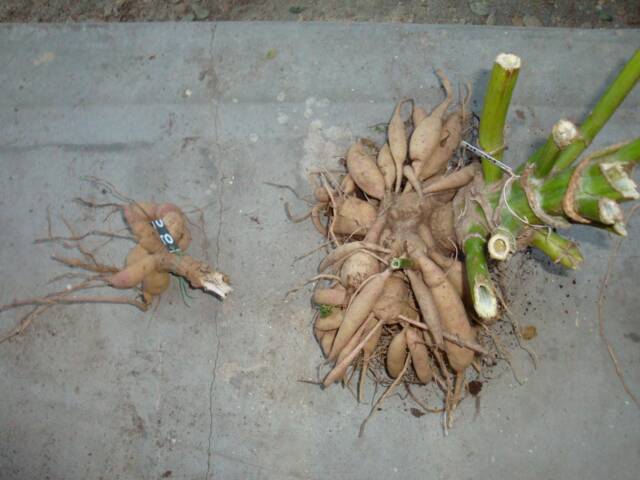
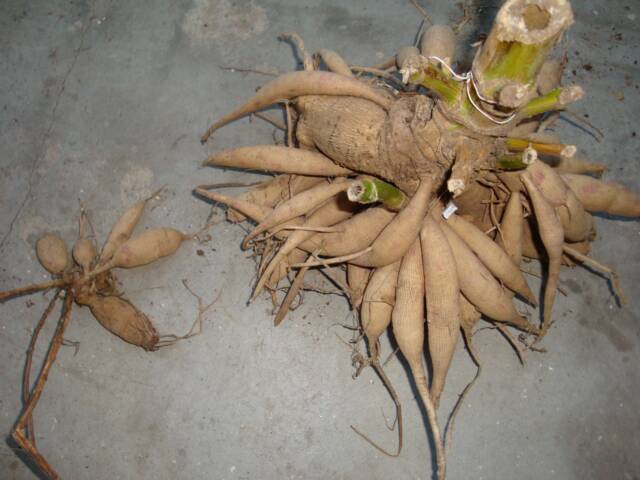
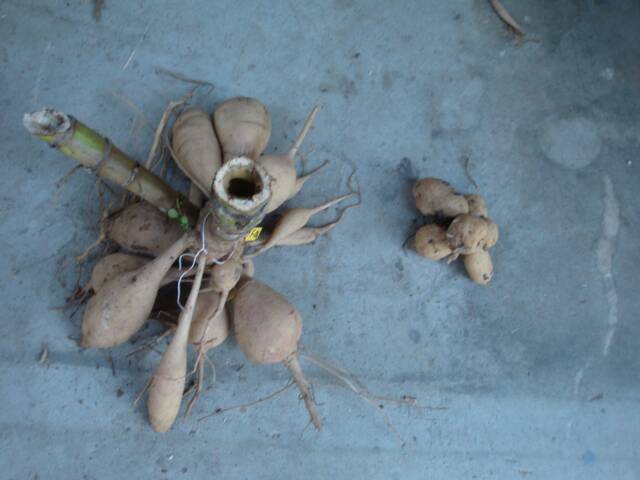
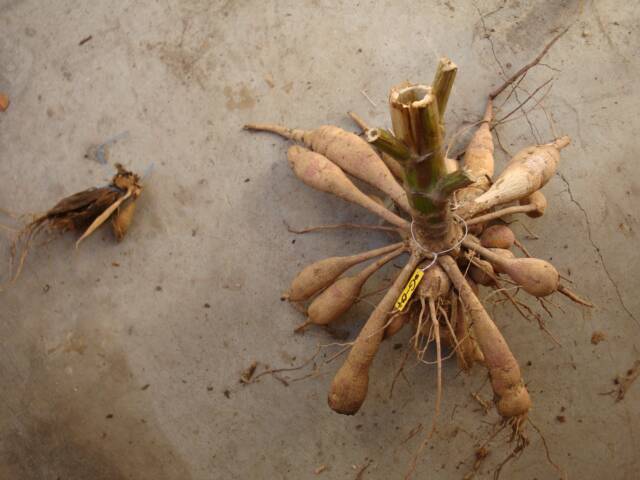
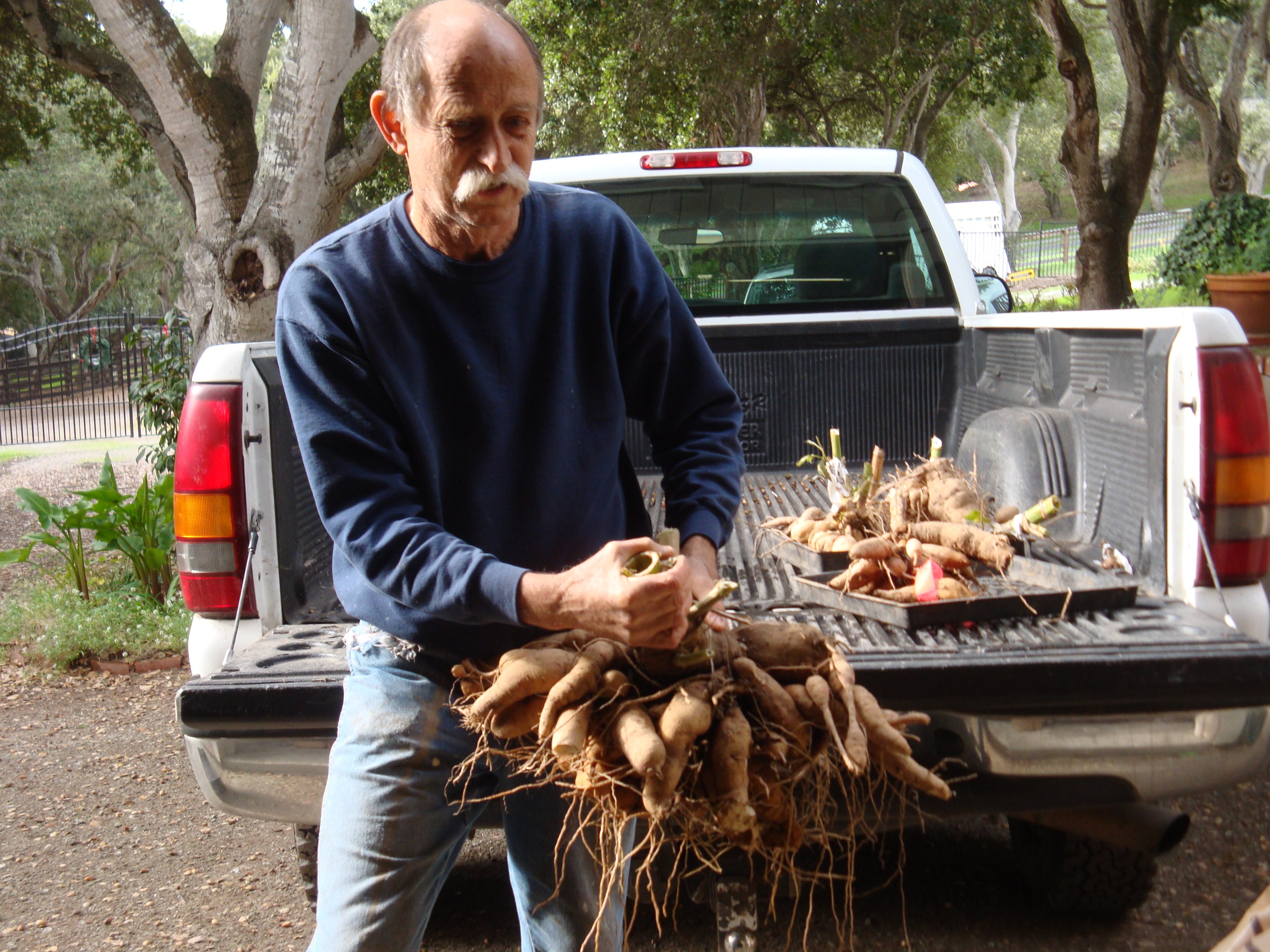
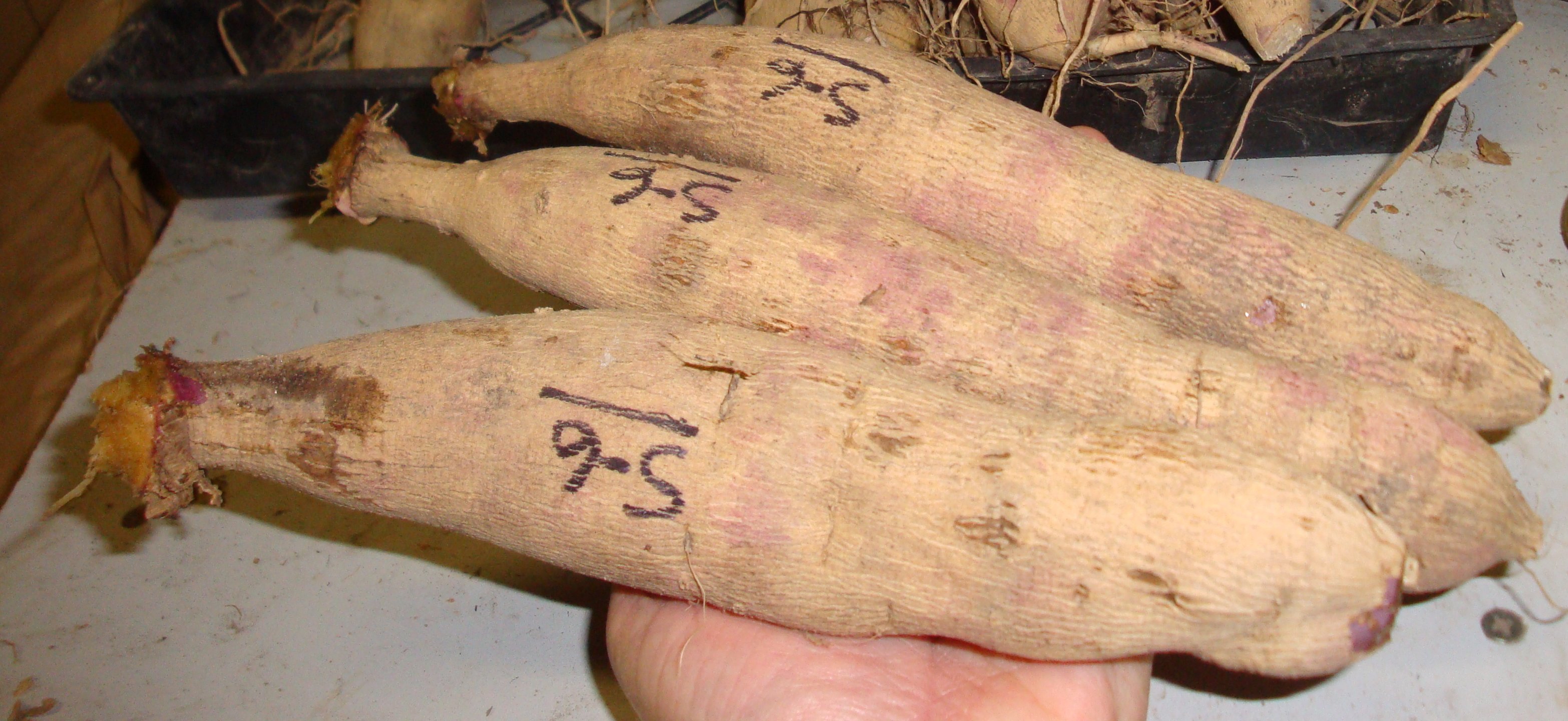
Over to the left, pictures say a thousand words.
You will see in the comparison of tuber clumps
after an entire season of growth.
We planted, one tuber and one cutting
of the same variety
next to each other
so we could conduct this test
under the best possible conditions.
The tiny clump
is always the one grown from a cutting
& the larger clump was grown from a tuber
with no difference in
location, soil, chemical additives,
sunlight, water, fertilizer.
We have bought cuttings from
commercial farms as well as societies.
Rather depressing don't you think.
I think this every time I have dealt with a cutting.
Some people think that a cutting performs more rapidly
than a dormant tuber without a sprout.
This is inaccurate information.
Dahlias from cuttings do not bloom earlier than a dormant tuber.
The dormant tuber will always out perform the cutting
in the time frame for blooming and flower size.
It's ridiculous to think a tuber is not going to sprout for you,
For years, I've seen dormant tubers sprout
out in the compost pile that we thought were dead.
If a tuber doesn't perform, it's usually the dirt,
weather, too much water or a pest, or a novice clump cutter.
It's obvious to us, after years of growing seasons,
that cuttings produce weaker plants.
some don't make it through the summer from problems.
They put out inferior blooms and less of them.
Many look sick from viruses
and then we have to destroy them.
Viruses cause a wide range of symptoms and damage.
Symptoms include occasional yellow spots or blotches,
mosaics, vein yellowing, yellow line patterns,
leaf margin yellowing and necrosis.
Plants and roots may be stunted,
deformed in shape,
leaves may role or cup and blossoms
and tubers may be suppressed in size and number.
Often virus symptoms can be confused
with mineral deficiencies,
other cultural problems and insect damage.
However, viruses very rarely rot or outright kill their host.
People will put lots of money into virus research.
Why not put lots of money into healthy tubers
and forget the cuttings.
Then, there will not be a virus problem
and poor root production running wild.
Besides from disease, other problems exist,
some dahlias grown from cuttings through out
an entire season have such
a tight root system resembling a tight ball
that one has a difficult time
separating the individual tubers.
Alot of the tubers are distroyed in the process.
They are too small to hold over the winter
and go through a second growing season
of unhealthy growth habits.
The second year the tubers can not spread out
and become a healthy clump. This is not a good thing.
[sorry I have no picture as of yet of this situation].
Cuttings are also more susceptible to pest.
Even if you put a perfectly healthy cutting in the ground,
the weakness of the plant with no bank account attracks
a pest or several different pest
that will suck the life out of it
rather quickly, which can also bring in or spread
disease more rapid.
If you read horticultural text books and others, such as
books by Christopher Lloyd and
The American Horticulture Society,
they all refer to the history and warnings of cuttings.
Roses, for instance, were propagated by cuttings
ages ago to the point where the plant can not produce good roots.
At that time, they started grafting hybrids
to older rootstock in order to keep the variety alive.
This older rootstock is capable of pushing the nutrients up into the cuttings faster so that the cutting can grow healthy.
Eventually, if given a natural existance long enough,
that new hybrid cutting
is capable of putting out it's own roots
and the root stock dies off.
The plant at that point has a chance to become very healthy.
However, here is the problem for the Dahlia.
You can not graft a hybrid dahlia cutting to a rootstock
of another Dahlia. And if you could,
I'd like to meet the person who pulls it off.
And even if he did.
wouldn't it be better to protect the dahlia family
at large from such a historical problem?
A problem that is already starting to exist.
My opinion, we are already seeing a problem 2010.
We were seeing a problem in 2000 with cuttings,
but not on such a large scale.
Now, too many people are using
the theory of cuttings as a sport.
This is when one sees too many cuttings
being sold at society tuber sales
when tubers alone could just as easily be presented.
Like a contest of who is better at cuttings than the other.
We all have seen certain varieties
that have a health or disease issue going on
with them across the United States.
Disease, tiny roots that don't live through the winter,
flower deformation, slow growth.
These are the plants that people got overly anxious
to propagate, so they can be sold or brought
into the growers spectrum faster
than a new hybrid can possibly handle.
If everyone would take on the respect
of giving that hybrid 1 to 2 more years
to slowly multiply at it's own beautiful success rate.
We would all have healthier Dahlias
as a whole and more of them and bigger flowers.
There would be a faster propagation rate
for specific varieties if everyone would give it
time to grow by tubers only. Yes!
I see older varieties right now that are not producing
as superior of a flower as it did 8-10 years ago,
with lousy tuber growth. These were strong great plants.
That's a huge problem wide spread,
that's not that much time for these beautiful varieties
to become weak.
If exploiting a plant's natural regenerative abilities
keeps going on, these older flowers will be discarded
as old inferior plants- not worth growing.
You can not tell me that Dahlia varieties
have a short life for health and vitality and competition.
I have to agree that if a certain variety of a dahlia
is about to expire and propagation through taking
cuttings is a necessary way of saving the hybrid.
This is an ideal way to try to accomplish just that.
But, there is a point where the variety has to return
to it's natural growth habits in order to become
strong and healthy again.
Also, I'm aware of Dahlia Growers in very cold winter
climates with cold wet spring weather, and extremely hot springs.
These people use cuttings
because they have learned to make it work for them.
It's a way to put a plant in the ground
earlier with less of a rot problem.
Or is it the ultimate solution?
I have talked to growers in the Michigan area that swear
by the fact that the best way to grow dahlias,
after years of trial and error,
is to put the tuber [not cuttings],
unsprouted, in the ground on June 1st, exactly.
No sooner, no later, or you will have problems.
Why do people want cuttings?
One answer is: that it is a poor man's
way for getting more plants
for a small price at the risk of loosing everything.
Alot of these growers want to blame
the commercial grower for the loss of a tuber
that just does not want to cooperate,
however, history and experience continually proves
that is not the case.
We have decided to only sell tubers
from a tuber grown plant
so that we can continue
to provide
the highest quality
and healthiest Dahlias
for your landscaping
& show entries.
Want to win at a show, grow my plants!
We do not force tubers to produce extra sprouts
or take any cuttings from the plants
to gain inventory.
This is why, after years of a certain variety
being grown at my farm,
the stronger and healthier that variety will get.
And for some reason, my yeild is incredible!
Here is another interesting cultural thought:
We do not stake any of our dahlias.
They do not fall over. They grow as tall as everyone elses,
blow in a pretty strong breeze coming off the ocean.
Dahlias are not invalids needing constant support.
I believe this is also why our tubers are strong and healthy.
They have a chemical reaction happening, as trees do,
to the organic movement of the weather
that creates them to grow upright and strong.
Ethylene activity causes plants to lean away
from prevailing winds.
This response to wind stress strengthens
the plant to withstand further damage.
Young plants that are blown about by the wind
grow stronger and sturdier
than those grown with a supporting stake.
You have to take the stake off
to let the plant sway in the wind to grow straight
and tall on it's own.
If you are a hybridizer, and especially in a colder climate,
you might want to consider sending us a tuber
so we can protect the variety's health for many years to come.
We are a State Ag Regulated Natural Flower Farm [no pesticides].
This means we used advanced methods of pest control
and there is no harsh chemical residue absorbed
into our Dahlia plants at the cellular level.
Plants can only absorb so much poison
before it starts to alter it's ability to function
with the correct habits of it's DNA.
Further more, humans can only absorb so much poison as well.
We're like the Dahlia Tuber Health Spa and Rejuvenation Hospital!
We only grow Dahlias
in a traditional field grown farming method.
And we are asking you to please consider doing the same.
Become a conservationist of the Dahlia.
Happy Spring, Summer and Fall, 2011
to all of you, Sincerely, Colleen